Why women gain weight: causes, evidence, and solutions


Weight gain in women is one of the most misunderstood topics in health. For too long, the conversation has been reduced to willpower, portion sizes, or simply “eating less and moving more.” But that framing leaves out the real story. Hormones, muscle loss, medical conditions, sleep quality, and stress all interact in ways that make weight management genuinely complex for women, especially between ages 25 and 50. We want to change that narrative, because when you understand what’s actually driving weight gain, you can make smarter, more effective choices that actually last.
Table of Contents
Key Takeaways
Point | Details |
Multiple causes of weight gain | Hormonal shifts, metabolism changes, medical conditions, and lifestyle behaviors all drive female weight gain. |
Muscle matters most | Preserving muscle mass is crucial for reducing weight regain and supporting a healthy metabolism. |
Multi-pronged solutions work | Effective weight management combines medical support, coaching, and lifestyle tweaks—not just diet or exercise alone. |
Virtual support improves results | Digital coaching and app engagement paired with GLP-1 medication deliver sustained weight loss outcomes. |
Core biological drivers: Metabolism, muscle, and hormones
Let’s start with what’s happening inside your body. As women age, two major biological shifts quietly work against weight management. First, we naturally lose muscle mass, a process called sarcopenia that begins as early as our 30s. Muscle is metabolically active tissue, meaning it burns calories even when you’re resting. When muscle decreases, your resting metabolic rate drops too, so your body burns fewer calories throughout the day without you doing anything differently.
Second, hormonal changes play a significant role. Estrogen isn’t just a reproductive hormone. It actively influences where your body stores fat. As estrogen levels decline, particularly during perimenopause and menopause, fat tends to shift toward the abdomen. This “central” or “apple-shaped” fat distribution is not just a cosmetic concern. It’s associated with greater metabolic risk.
According to The Menopause Society, midlife weight gain is driven by a mix of aging-related metabolism and muscle loss, hormone changes around menopause especially lower estrogen leading to central fat, and lifestyle factors like lower activity and sleep or stress disruption.
Biological Factor | Effect on Weight | When It Starts |
Muscle loss (sarcopenia) | Lowers resting metabolism | As early as age 30 |
Estrogen decline | Shifts fat to abdomen | Perimenopause (avg. age 40s) |
Slower thyroid function | Reduces calorie burn | Varies; worsens with age |
Insulin sensitivity changes | Increases fat storage | Midlife and beyond |
These changes don’t happen overnight, and they don’t happen in isolation. They stack on top of each other, which is exactly why standard dieting advice often falls flat for women in their 30s and 40s.
“Weight gain during midlife isn’t a failure of willpower. It’s a predictable response to real biological changes that require real, targeted solutions.”
Pro Tip: Tracking not just your weight but also your energy levels, sleep quality, and mood can help you spot hormonal or metabolic changes early, giving you more power to respond before weight gain accelerates.
Medical conditions and their impact: The case of PCOS
While hormones and metabolism play major roles, medical conditions can further complicate weight management. Polycystic ovary syndrome, or PCOS, is one of the most common hormonal disorders in women of reproductive age, affecting an estimated 1 in 10 women. And its connection to weight gain is both significant and often misunderstood.
PCOS creates a hormonal environment that actively promotes fat accumulation. Women with PCOS typically have higher levels of androgens (male-type hormones like testosterone) and are more likely to experience insulin resistance. Insulin resistance means your body needs more insulin to do the same job, and excess insulin is a powerful driver of fat storage, especially around the midsection. Research shows that PCOS contributes to weight gain via insulin resistance and higher androgen levels, which are associated with increased body weight and typically an abdominal fat pattern.
Factor | Women with PCOS | Women without PCOS |
Insulin sensitivity | Often impaired | Usually normal (unless other causes) |
Androgen levels | Elevated | Normal range |
Fat distribution | Tends to be abdominal | Varies; more evenly distributed |
Metabolism | More resistant to change | More responsive to diet and exercise |
Weight loss difficulty | Higher | Moderate |
Here’s what matters most about PCOS and weight:
Weight loss is harder, but absolutely achievable with the right support
Standard calorie restriction alone is often insufficient because of insulin resistance
Reducing refined carbohydrates and sugar helps more than a generic low-calorie approach
Resistance training is especially valuable for improving insulin sensitivity
Medical intervention, including GLP-1 medications, can be a game-changer for managing PCOS symptoms alongside weight
Pro Tip: If you’ve struggled with weight loss and also experience irregular periods, acne, or excess hair growth, talk to your provider about screening for PCOS. Getting an accurate diagnosis changes everything about your strategy.
The emotional dimension matters here too. Women with PCOS often feel like they’re doing everything right and still not seeing results. That frustration is valid and understandable. The biology really is working against you, but targeted strategies do work.
Lifestyle and behavior: Why habits and environment matter
Medical conditions are just one part of the story. Daily habits and environment can reinforce or offset biological risks. And for many women between 25 and 50, the lifestyle landscape is genuinely stacked with challenges.
Consider what a typical week looks like: managing a career, raising kids or caring for aging parents, squeezing in social commitments, and trying to get enough sleep. Physical activity often gets pushed aside. Stress levels stay elevated. Sleep is interrupted or cut short. Each of these factors independently influences weight, and together they create a powerful reinforcement loop that makes weight gain much easier than weight loss.
The Menopause Society identifies lifestyle factors including lower activity, sleep disruption, and stress and sleep tips as key drivers of midlife weight gain, working alongside hormonal and metabolic changes.
Here are the top lifestyle shifts that most directly affect weight in women aged 25 to 50:
Reduced physical activity. Many women move less as responsibilities increase. Even small reductions in daily steps or active time accumulate into significant metabolic consequences over months and years.
Poor sleep quality or quantity. Sleep below 7 hours per night disrupts cortisol, ghrelin, and leptin, the hormones that regulate hunger and fat storage. You wake up hungrier and less satisfied by food.
Chronic stress. Elevated cortisol signals your body to store fat, particularly abdominal fat. It also drives cravings for high-sugar, high-fat foods as a quick energy fix.
Irregular or skipped meals. This disrupts blood sugar regulation and often leads to overeating later in the day, especially in the evening when metabolism is slower.
Alcohol consumption. Even moderate alcohol adds empty calories and disrupts sleep, creating a compounding effect on weight management.
“Small, consistent lifestyle shifts matter more than dramatic overhauls. Building sustainable habits around sleep, movement, and stress is one of the highest-leverage things you can do for your weight.”
The good news is that lifestyle factors are the most changeable part of the equation. While you can’t stop aging or reverse a PCOS diagnosis overnight, you can take real steps today to improve sleep, reduce stress triggers, and add movement into your routine. These changes genuinely shift outcomes.
Sustaining weight loss: The importance of lean mass, coaching, and medication
Lifestyle changes work best when paired with evidence-backed strategies that sustain long-term progress. This is where the conversation gets exciting, because the science on what actually works for women is getting clearer and more actionable.
One of the most important and underappreciated factors in long-term weight management is preserving lean muscle mass during weight loss. Many popular diets cause people to lose both fat and muscle. Losing muscle is a problem because it lowers your resting metabolism and sets the stage for weight regain once the diet ends. Research shows that losing fat-free mass during weight loss is associated with more weight regain, and approaches that conserve lean mass through resistance training and adequate protein intake can significantly improve long-term results.
Strategy | Effect on Lean Mass | Weight Loss Outcome |
Resistance training 2 to 3x/week | Preserves or builds muscle | Better fat loss, less regain |
High-protein diet (1.2 to 1.6g/kg body weight) | Reduces muscle breakdown | Improved body composition |
Cardio only | May accelerate muscle loss | Initial loss; higher regain risk |
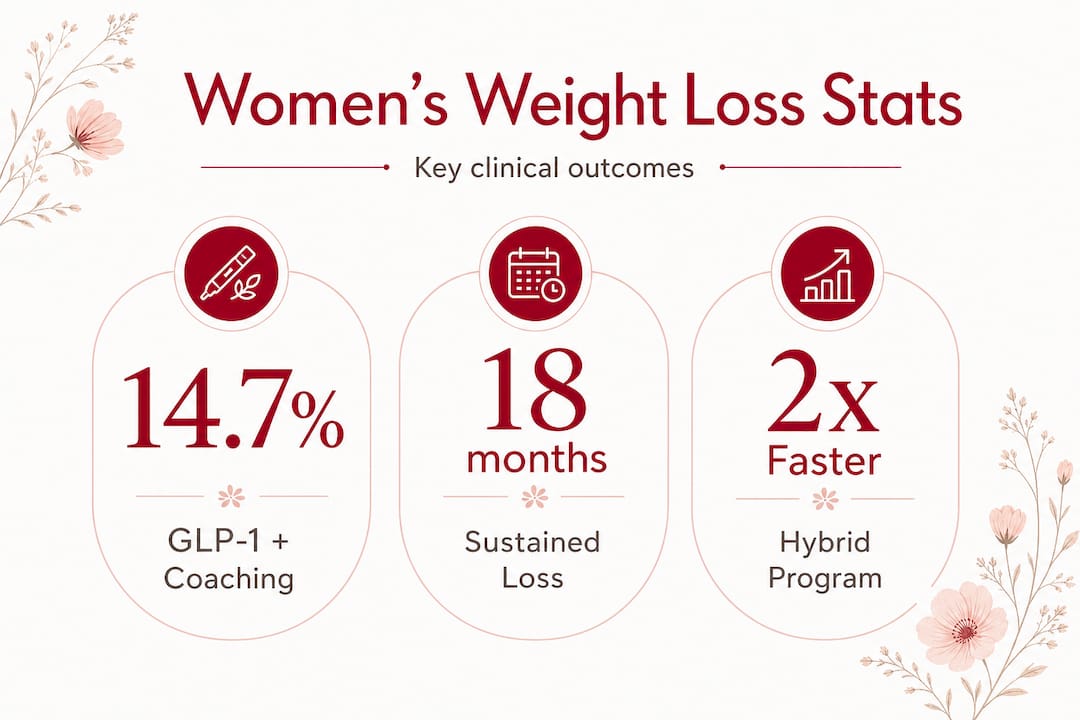
GLP-1 medication plus coaching | Supports fat loss, preserves function | Up to 14.7% loss at 18 months |
Here’s a practical approach to preserving lean mass while losing weight:
Prioritize protein at every meal, aiming for 25 to 35 grams per serving
Include resistance training at least twice per week, even light bodyweight exercises count
Avoid very low-calorie crash diets that sacrifice muscle for quick results
Stay consistent with coaching and check-ins to adjust your plan as your body changes
Consider GLP-1 medications if you’ve struggled with appetite regulation or significant metabolic resistance
Speaking of GLP-1 medications, the evidence is genuinely impressive. A 2026 paper in the International Journal of Obesity found that GLP-1 combined with behavioral coaching can produce clinically meaningful weight loss outcomes in real-world settings. Programs pairing medication with digital support tools and coaching contacts consistently outperform medication alone or lifestyle advice alone.
Key stat: Women using a hybrid GLP-1 plus coaching program achieved up to 14.7% total body weight loss at 18 months. That’s not a clinical trial number. That’s a real-world result from women using a program structured very much like what we offer here at Wildflower.
Pro Tip: If you’re considering GLP-1 medications like Semaglutide or Tirzepatide, pairing them with structured coaching and a protein-forward nutrition plan dramatically improves your outcomes compared to taking medication without support.
Virtual programs make all of this more accessible. Weekly coaching calls, secure provider messaging, and AI-personalized training help you stay consistent without needing to rearrange your schedule around a gym or in-person clinic. Engagement matters. Higher contact with your program means better outcomes, and virtual formats make that contact more sustainable for busy women.
Why one-size-fits-all approaches fall short
We’ve seen the full picture now, and we want to be direct about something important. The “just eat less and move more” advice isn’t just oversimplified. For many women, it’s counterproductive. When women hear that messaging and still struggle, they internalize the failure as a personal flaw. That’s not just unhelpful. It’s harmful.
The truth is that weight gain in women involves a genuinely complex web of interacting factors: aging metabolism, muscle loss, estrogen decline, insulin resistance, cortisol from stress, sleep disruption, and underlying conditions like PCOS. No single cause explains the full picture, and no single fix addresses it.
We’ve seen this play out repeatedly. A woman cuts calories aggressively, loses weight initially, but then hits a wall and regains. Why? Because she lost muscle along with fat, her metabolism dropped, and her hunger hormones ramped up. The biology pushed back. That’s not a lack of discipline. That’s a predictable physiological response to an incomplete strategy.
The Menopause Society makes it clear: effective solutions for midlife weight gain need to be multi-pronged, addressing hormone changes, muscle preservation, lifestyle factors, and medical support together. This perspective aligns with expert weight loss advice that goes beyond calorie counting to address the full system.
Research also supports a more nuanced view: energy balance still matters, but preserving lean mass and managing appetite and behavior changes likely determines whether weight comes off and stays off for women 25 to 50.
Sustainable weight management looks like: personalized nutrition that respects your hormonal profile, resistance training that protects your muscle, sleep and stress strategies that calm your cortisol, and professional support through coaching or medication when biology needs extra help. It’s not a single intervention. It’s a system designed for your real life.
Take the next step: Evidence-based support for your weight journey
You now have a clearer, more honest picture of why women gain weight and what actually works to change it. That knowledge is powerful, and the right support makes it actionable.
At Wildflower, we built our entire program around this evidence. We know weight loss for women isn’t a willpower problem. It’s a biology and support problem. That’s why we offer a full system: GLP-1 medications including Semaglutide, Tirzepatide, Mounjaro, Wegovy, and more paired with weekly live coaching calls, AI-personalized training, and a community of women who get it. Explore our holistic weight loss method, join one of our weight loss challenges designed to build momentum fast, or simply get started today. Real results come from real, personalized support, and we are here for every step of your journey.
Frequently asked questions
Is weight gain inevitable as women age?
No. While aging increases biological risks like muscle loss and hormone changes, effective strategies including muscle preservation, protein intake, and lifestyle adjustments can significantly reduce or prevent weight gain.
How does PCOS affect weight loss efforts?
PCOS causes insulin resistance and elevated androgens that make fat loss harder, but targeted strategies including low-glycemic nutrition, resistance training, and medical support make meaningful weight loss achievable.
What role do sleep and stress play in women’s weight gain?
Sleep disruption and chronic stress directly worsen hormonal balance, elevate cortisol, and increase hunger hormones, all of which promote weight gain and make loss harder. Addressing these factors is essential, not optional.
Can GLP-1 medication help with weight loss for women?
Yes. GLP-1 medication combined with coaching produces clinically meaningful and sustained weight loss in real-world settings, with results significantly better than either approach alone.
Why is muscle mass so important when trying to lose weight?
Losing muscle during weight loss is one of the strongest predictors of future weight regain. Preserving lean mass through resistance training and adequate protein keeps your metabolism higher and your results lasting longer.
Recommended