
Why weight loss slows down: understanding plateaus
- Anne Marie Noe

- Jun 24
- 9 min read

You push through every workout, track every meal, and stay committed to your goals, yet the scale just stops moving. Sound familiar? Most women hit this invisible wall at some point, and it has nothing to do with willpower or failure. Your body is working against you in the most sophisticated way possible, making biological adaptations that actively resist further weight loss. The good news? Understanding exactly what is happening, including hormonal shifts like leptin dropping 40-60% after weight loss, gives you the power to adjust your approach and keep moving forward.
Table of Contents
The hidden adaptations: why your body resists ongoing weight loss
Medication and GLP-1s: why progress may stall on popular weight loss drugs
Breaking through a plateau: evidence-based strategies for restarting progress
The uncomfortable truth (and opportunity) about weight loss slowdowns
Ready for expert support? Transform your approach with Wildflower
Key Takeaways
Point | Details |
Adaptation is universal | Your body naturally slows weight loss over time through hormonal and metabolic adjustments. |
Women’s biology matters | Female hormone patterns and life stages create unique challenges that can intensify plateaus. |
Medications are not magic | Even GLP-1 drugs cause plateaus as your body adapts, but strategies exist to keep improving. |
Sustainable tweaks win | Lasting progress comes from adjusting nutrition, activity, and expectations—not just pushing harder. |
Expert support helps | Specialized programs and coaching can guide you through slowdowns and help break through plateaus. |
The hidden adaptations: why your body resists ongoing weight loss
To understand why your progress slows, let’s uncover the surprising adaptations your body makes after you start losing weight. Your body is remarkably intelligent, and when it senses that fat stores are shrinking, it launches a full defense response designed to protect you from what it perceives as a threat.
One of the most significant changes is metabolic adaptation, sometimes called adaptive thermogenesis. As your weight drops, your body burns fewer calories simply because there is less of you to maintain. But here is the surprising part: your metabolism slows even more than body size alone would explain. For every 1 kg lost, energy expenditure drops 20-30 calories per day, and appetite simultaneously increases by roughly 100 calories. That double hit is why the gap between what you eat and what you burn narrows so quickly.
At the same time, your hunger-regulating hormones shift dramatically:
Leptin signals fullness to your brain, and it drops 40-60% after significant weight loss, remaining about 35% below baseline even after one year.
Ghrelin, the hunger hormone, rises 20-30% and stays elevated long term.
Thyroid hormones can decrease slightly, further dampening your metabolic rate.
Peptide YY and GLP-1 (appetite suppressants) also decline with continued caloric restriction.
Adaptation | What happens | Effect on your body |
Leptin decline | Drops 40-60% | Reduced fullness signals, increased hunger |
Ghrelin rise | Increases 20-30% | Stronger hunger drive throughout the day |
Metabolic slowdown | 20-30 cal/day per kg lost | Fewer calories burned at rest |
Muscle loss | Accompanies fat loss | Further reduces daily calorie needs |
“Your body does not know you are trying to lose weight. It only knows you are in an energy deficit, and it is programmed to fight that with everything it has.” This is why plateaus are not a sign that you are doing something wrong. They are a sign that your body is doing exactly what it evolved to do.
Pro Tip: Tracking your hunger levels alongside your weight can reveal a lot. If your appetite is significantly higher than when you started, your leptin and ghrelin may be driving the plateau, not your habits. Visit our women’s weight loss blog for more on how to read and respond to your body’s signals.
Unique challenges for women: hormones, cycles, and plateaus
While everyone adapts to weight loss, unique biological factors make plateaus even more challenging for women. The interplay of estrogen, cortisol, and monthly hormonal cycles creates a weight loss environment that is genuinely more complex than what men experience.
Estrogen and the post-40 shift. After 40, estrogen levels naturally decline, especially around perimenopause. This shift encourages your body to store more visceral fat around the abdomen, even when you are eating the same way you always have. Lower estrogen also reduces insulin sensitivity, making it easier for your body to store fat and harder to burn it.

Cortisol and stress. Women tend to have a stronger cortisol response to psychological stress compared to men. Elevated cortisol promotes fat storage, particularly around the belly, and increases cravings for high-calorie comfort foods. Even when everything else is going well, a stressful week at work or family pressure can quietly stall your progress.
Monthly fluctuations. Your menstrual cycle causes natural, predictable weight swings that can feel discouraging. Water retention during the luteal phase (the two weeks before your period) can temporarily mask real fat loss, adding 1-5 pounds that disappear after your period begins. This means you might actually be making great progress while the scale tells a completely different story.
Factor | Women | Men |
Estrogen influence | High; declines sharply post-40 | Low; gradual testosterone decline |
Cortisol stress response | Often stronger | Typically milder |
Monthly weight fluctuations | Yes, 1-5 lbs common | Not applicable |
Visceral fat response to aging | Amplified after menopause | Gradual with age |
Baseline metabolic rate | Lower relative to body size | Generally higher |
Track your weight across your full monthly cycle, not just week to week.
Prioritize stress management as actively as you prioritize nutrition.
Talk to your provider about estrogen-related changes if you are over 40 and feeling stuck.
Pro Tip: Weigh yourself at the same point in your cycle each month for a true comparison. Week-to-week numbers can be misleading, but comparing the same week across two months gives you real data. Read more about maintaining balance during hormonal shifts for practical guidance.
Medication and GLP-1s: why progress may stall on popular weight loss drugs
Medications can help, but they are not immune to the body’s ability to adapt. Let’s break down what happens and what you can do next.
GLP-1 receptor agonists like semaglutide (Wegovy, Ozempic) and tirzepatide (Mounjaro, Zepbound) are genuinely powerful tools. They reduce appetite, slow gastric emptying, and help regulate blood sugar. But your body still adapts. On GLP-1 medications, plateaus typically occur between 20 and 60 weeks, as the body recalibrates to the new hormonal environment.
The STEP 1 clinical trial showed that the maximum average body weight loss on semaglutide was approximately 15% of starting body weight. That is impressive, but it also means most people will hit a ceiling. When you reach that ceiling, it does not mean the medication stopped working. It means your body has adapted enough that the drug’s effect is now balanced by compensatory mechanisms.
Stage | Typical timeline | What is happening |
Active loss phase | Weeks 1-20 | Strong appetite suppression, rapid initial loss |
Slowing phase | Weeks 20-40 | Body compensates, metabolic rate adjusts |
Plateau phase | Weeks 40-60+ | Weight stabilizes despite continued medication |
Adjusted response | Ongoing | New equilibrium established at lower weight |
Here is what you can do when progress stalls on medication:
Talk to your provider about a dose adjustment. Higher doses, such as semaglutide at 7.2 mg, can sometimes restart progress when an earlier dose has plateaued.
Consider switching to a dual agonist. Tirzepatide targets both GLP-1 and GIP receptors, offering a different mechanism that may restart progress when a single agonist has stalled.
Prioritize protein intake. GLP-1 medications can suppress appetite so much that some women are not eating enough protein, leading to muscle loss that further slows metabolism.
Add resistance training. Preserving muscle mass is critical during any medically assisted weight loss period. Muscle keeps your metabolic rate from dropping too far.
Review lifestyle factors. Sleep deprivation and chronic stress blunt medication effectiveness, so addressing those can move the needle.
Pro Tip: If you are on a GLP-1 medication and feeling like nothing is happening, do not stop the medication without talking to your provider first. A plateau on medication is different from the drug not working at all. Explore medication strategies for plateaus to learn what options are available to you.
Breaking through a plateau: evidence-based strategies for restarting progress
So, what can you actually do if your weight loss has stalled? Here is how to take actionable steps for continued results.
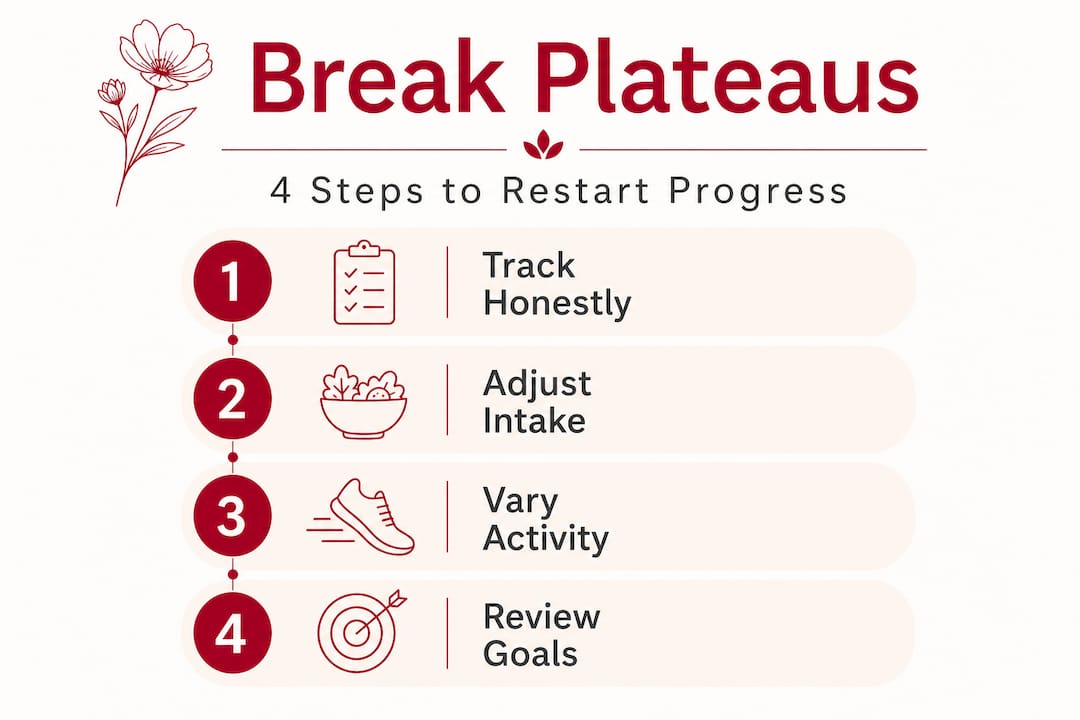
The most important thing to understand is that pushing harder with the same approach rarely works. If your body has adapted to your current calorie level and exercise routine, doing more of the same will not overcome the adaptation. You need to change the stimulus.
Nutrition adjustments that actually work:
Try a brief diet break, eating at maintenance calories for 1-2 weeks. Research shows this can partially reset leptin levels and reduce metabolic adaptation before you return to a deficit.
Reassess your actual calorie intake honestly. Many women unknowingly eat more after months of dieting because hunger hormones are elevated.
Exercise strategies that preserve muscle and restart fat loss:
“Resistance training is one of the most underutilized tools in women’s weight loss. Most women focus on cardio, but building and preserving muscle is what keeps your metabolism from crashing during a plateau.”
Aim for 2-3 strength training sessions per week, focusing on compound movements like squats, deadlifts, rows, and presses. These recruit large muscle groups and create a significant metabolic demand.
A key statistic: High-protein diets combined with resistance training can counter the lean mass loss that commonly accompanies GLP-1 medication use, protecting your metabolic rate for the long term.
Evaluate your sleep. Less than 7 hours a night elevates ghrelin and cortisol, both of which stall weight loss.
Manage stress actively. Yoga, walking, journaling, or simply protecting downtime all reduce cortisol.
Track your cycle and plan your eating and training around it. Higher carb intake during the luteal phase can reduce cravings without derailing progress.
Pro Tip: Before assuming you need to overhaul everything, spend one week logging your meals with complete honesty. Many plateaus break simply from discovering hidden calorie creep that happened gradually over months. Check out our expert advice on breaking plateaus and tips for sustainable changes for more ideas.
The uncomfortable truth (and opportunity) about weight loss slowdowns
Stepping back, it is time to rethink what a slowdown really means for your journey.
Here is what most mainstream weight loss advice ignores: your body’s resistance to continued weight loss is not a flaw. It is a feature. The same biological drive that makes plateaus frustrating is the same drive that kept your ancestors alive through famine, drought, and food scarcity. You are experiencing the result of millions of years of evolutionary survival programming. That is not your enemy. It is actually proof that your body is working perfectly.
We see women every day who interpret a plateau as personal failure. They double down on restriction, cut more calories, add more cardio, and feel exhausted and defeated when the scale still does not move. This approach almost always backfires. More restriction deepens metabolic adaptation, accelerates muscle loss, and raises cortisol, making the plateau worse over time.
The real opportunity in a plateau is this: it forces you to work smarter. It demands that you stop relying on willpower and start relying on strategy. The women who move through plateaus successfully are not the ones who suffer the most. They are the ones who adjust the most thoughtfully.
There is also a perspective shift worth considering. If you have lost 10, 15, or 20 pounds and hit a plateau, your body is maintaining a new, lower weight set point under constant biological pressure to return to where it started. That is genuinely hard work that your body is doing on your behalf. A plateau can actually be a sign of significant progress, not stagnation.
We believe that sustainable transformation comes from understanding your body, not fighting it. Explore deeper perspectives on weight loss to keep building that understanding alongside us.
Ready for expert support? Transform your approach with Wildflower
If you have been pushing through a plateau on your own and feeling stuck, you do not have to keep guessing. At Wildflower, we are a virtual weight loss program built by women, for women, and we understand exactly how frustrating it feels to work hard without seeing results.

We offer personalized access to weight loss medications including Mounjaro, Zepbound, Ozempic, Wegovy, Semaglutide, Tirzepatide, and more, paired with AI personalized training and a customizable dietary system designed around your life. Weekly live group health coaching calls, secure texting with your provider, virtual weigh-ins, and monthly Girl’s Nights make this a community, not just a program. Whether you are just starting out or working through a stubborn plateau, we are here to support every step. Start your journey today, explore our current challenges, or learn more about our full virtual weight loss program to see how we can help you move forward.
Frequently asked questions
How long does a typical weight loss plateau last?
Most plateaus last anywhere from a few weeks to several months, and on GLP-1 medications like semaglutide, they typically occur between weeks 20 and 60 as the body adapts. Making strategic adjustments to nutrition, exercise, or medication can shorten that window significantly.
Why does my appetite increase after I lose some weight?
After weight loss, ghrelin rises 20-30% and stays elevated long term, while leptin drops significantly, reducing your brain’s fullness signals. This hormonal combination makes you genuinely hungrier, not just less disciplined.
Do women face different challenges than men when losing weight?
Yes, women experience amplified plateau effects due to estrogen decline, cortisol elevation, and menstrual fluctuations that can mask real progress and drive stronger visceral fat storage, especially after age 40.
What can I do when weight loss stalls on GLP-1 medications?
Strong options include adjusting your dose, switching to a dual agonist, or adding high-protein diets and resistance training to counter lean mass loss and support your metabolic rate during the plateau.
Can stress or monthly cycles cause temporary weight increases?
Absolutely. Elevated cortisol from stress promotes water retention and fat storage, and menstrual fluctuations can cause 1-5 pound swings in water weight that temporarily mask actual fat loss progress.
Recommended