
Why Community Helps Weight Loss: a Women's Guide


Most women assume weight loss is a personal battle fought alone. You set a goal, track your meals, and push through workouts on willpower. But research tells a different story about why community helps weight loss. Studies consistently show that women who engage with supportive groups lose more weight, stick to their plans longer, and feel better doing it. This guide breaks down the science, the structure, and the practical steps to help you use community as one of the most powerful tools in your weight loss program.
Table of Contents
Key takeaways
Point | Details |
Community drives better outcomes | Women in structured community programs achieve clinically meaningful weight loss at nearly three times the rate of solo efforts. |
Structure matters as much as support | Effective programs combine nutrition education, goal setting, physical activity, and professional feedback. |
Emotional benefits are real | Peer support reduces isolation, lowers stress, and keeps motivation strong through plateaus and setbacks. |
Hybrid models work best | Combining online and in-person community touchpoints increases access and sustains long-term engagement. |
Individual commitment still counts | Community amplifies your effort. It does not replace the personal choices you make every day. |
Why community helps weight loss: the science
The idea that going it alone is the toughest and most respectable path is one of the biggest myths in weight loss. Science disagrees with it firmly.
Research shows that rapid weight loss programs with community support achieve clinically meaningful BMI targets at a rate of 28.3% versus just 9.7% for gradual, solo efforts at one year. That gap is not a small edge. That is nearly three times the success rate. And the difference comes down largely to structure and the people around you.
Here is what the evidence shows community support actually does:
Reduces isolation. Many women feel shame or loneliness around their weight. Knowing others share the same challenges dissolves that barrier fast.
Creates accountability. When someone else knows your goals, you are significantly more likely to follow through. It shifts your commitment from private intention to public promise.
Provides peer encouragement. Support groups give participants stronger adherence and better emotional resilience, according to research on community weight loss interventions.
Models success. Watching another woman hit a milestone you are working toward is one of the most motivating experiences in any program.
“Participants in community-based weight management programs consistently report that peer support is what keeps them coming back, especially when motivation dips.” — Research from Improving Weight Loss Outcomes of Community Interventions
The social support and weight loss connection is not just emotional. It changes behavior. Women who check in regularly with a group are less likely to fall back into old eating habits, because consistent peer accountability correlates directly with sustained results.
What makes a community weight loss program actually work
Not all community is created equal. There is a real difference between a casual Facebook group where people post motivational quotes and an evidence-based program with structure behind it.
Effective community programs rely on four core components working together. Understanding these helps you choose wisely.
Program element | Informal social group | Structured community program |
Nutrition education | Rarely provided | Guided by a dietitian or health coach |
Goal setting | Vague or self-directed | Clear, measurable, and professionally supported |
Physical activity | Optional suggestions | Built into the program structure |
Professional feedback | Absent | Regular check-ins with qualified providers |
Accountability system | Inconsistent | Weekly weigh-ins or scheduled touchpoints |
The role of community in weight loss depends heavily on who is guiding it. Trained coaches, registered dietitians, and medical providers bring a level of personalization that peer encouragement alone cannot replicate. Programs lacking this professional layer often fail to produce sustainable results.
Research also shows that community involvement is highest during the planning stage of a program at 88%, drops to 71% during delivery, and falls to just 34% during evaluation. That drop-off is where most programs lose their momentum. The best programs are designed to keep you engaged at every stage, not just the exciting beginning.
Pro Tip: When evaluating any community weight loss program, ask specifically how they support members past the first four weeks. If they cannot answer that clearly, keep looking.
Emotional benefits of peer support for women
The practical benefits of community are measurable. The emotional ones are just as real, and for many women, they are what make the difference between quitting and continuing.

Weight loss is hard. Plateaus are discouraging. Bad weeks happen. What community does in those moments is give you a soft place to land without letting you quit.
Post-bariatric patients with strong community support maintain weight loss better and attend follow-ups more consistently. They also report a noticeably better quality of life. This pattern holds for women in all types of structured weight programs, not just surgical ones. The group dynamic creates a form of accountability that feels supportive rather than judgmental.
Here is what women in strong peer support groups consistently experience:
A shared language. You stop having to explain why a slice of birthday cake is complicated. The group gets it.
Practical tips that actually work. Peers share real advice about managing cravings, dealing with stress eating, and fitting workouts into a busy schedule.
Morale boosts during plateaus. Hearing that another woman pushed through a three-week stall and came out the other side is far more encouraging than reading about it in an article.
Reduced stress. Social support lowers cortisol levels, and since cortisol drives fat storage, this benefit goes well beyond emotional comfort.
“The community role in weight loss is not just cheerleading. It is a genuine psychological buffer against the stress and self-doubt that derail so many women.”
Group motivation for losing weight works because it taps into something deeply human. We are wired to perform better, persist longer, and feel more capable when we are part of something bigger than ourselves.
For tips on staying motivated year-round, the women’s weight loss blog at Wildflowerweightloss has practical guides worth bookmarking.
Practical ways to engage with community for weight loss
Knowing community helps is one thing. Knowing how to actually find and use the right community is another. Here is a straightforward approach.
Look for programs with medical oversight. What is community-based weight loss at its best? It combines peer support with professional guidance. Look for programs that include a physician, nurse practitioner, or registered dietitian on the team.
Consider a virtual model. Online and in-person programs both work, but virtual models are increasingly effective at overcoming geographic barriers and keeping women engaged over time. Live video coaching calls, group chats, and virtual weigh-ins bring the community to you.
Show up consistently. This sounds obvious, but most community programs lose members who “lurk” without participating. Regular check-ins, shared goals, and open communication are what separate women who see results from those who do not.
Set shared goals with your group. When your community rallies around a specific milestone together, the group energy multiplies. Even something as simple as a monthly step challenge creates a shared focus.
Be honest about your challenges. The women who get the most out of community programs are the ones who share their real struggles. Vulnerability invites genuine support.
Pro Tip: If you are managing holiday temptations or tough seasonal periods, staying connected to your community is one of the most effective strategies. This guide on maintaining habits year-round is a great place to start.
Programs lacking structure or professional oversight can sometimes create unhelpful group dynamics, including competitive pressure or misinformation about nutrition. Always vet the program before committing your time and energy to it.
Community versus solo weight loss: the honest comparison
Some women genuinely prefer working alone. That is valid. But understanding the trade-offs helps you make an informed choice.
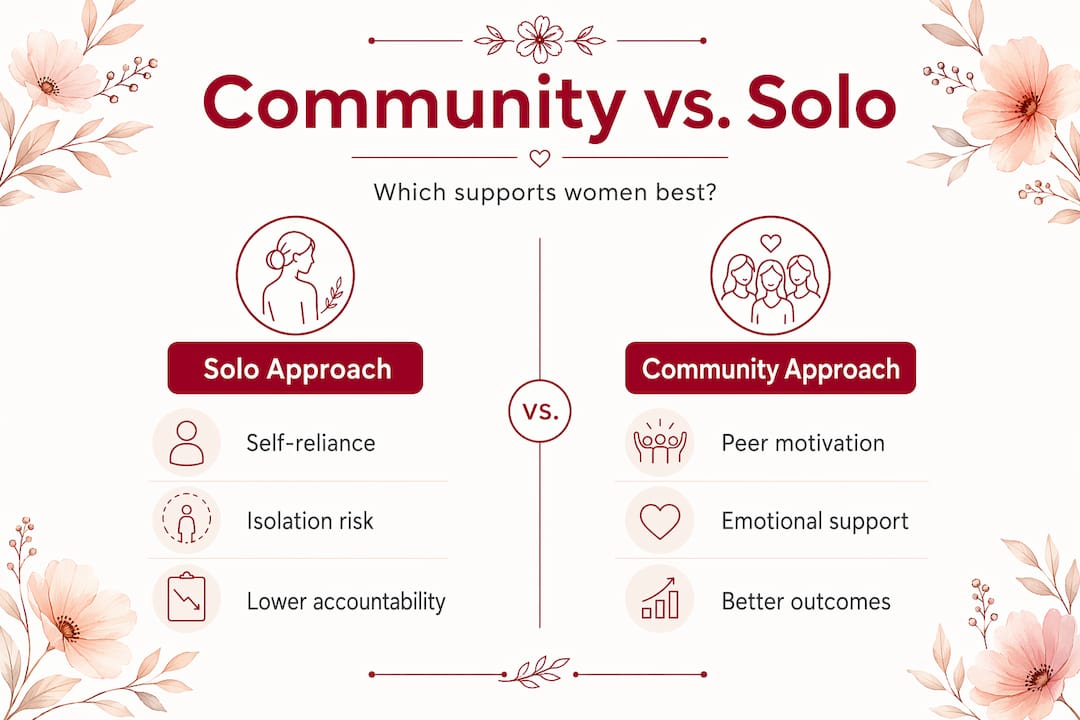
Category | Solo approach | Community approach |
Accountability | Self-directed, easier to abandon | External accountability increases follow-through |
Motivation | Can fluctuate without external input | Group energy sustains motivation during hard weeks |
Knowledge | Limited to self-research | Access to peer experience and professional guidance |
Emotional support | Isolated during setbacks | Shared resilience and encouragement |
Success rate | Lower, especially long-term | Significantly higher in structured programs |
The benefits of support groups for weight loss are clearest when you look at long-term outcomes. Solo efforts often start strong and fade because there is no structure holding you accountable when life gets busy. Community programs build that structure in from the start.
That said, community does not do the work for you. The women who thrive in group programs are the ones who bring their individual commitment to every session. Community amplifies what you bring. It does not replace it.
My take on why community changed everything
Choosing the right community matters a lot. Look for one with real structure, professional support, and women who show up honestly. The how community aids weight loss question gets answered fast when you are in a room of women who are doing the work alongside you.
If you are still going it alone, I want you to know that asking for support is not weakness. It is one of the smartest choices you can make.
— Anne Noe, NP
Start your journey with Wildflower Weight Loss
If this article resonated with you, we want you to know there is a program built exactly with you in mind.
Wildflower Weight Loss is a virtual weight loss program designed by women, for women. We combine medically supervised care, including access to medications like Mounjaro, Ozempic, Wegovy, and Tirzepatide, with a community experience that keeps you supported every step of the way. Weekly live group health coaching calls, virtual weigh-ins, live video open office hours, and monthly Girl’s Nights are built into every program. You get professional guidance and real peer connection in one place. Explore our full list of women’s weight loss programs and find the one that fits your life. We are ready when you are.
FAQ
Why does community help with weight loss?
Community provides accountability, emotional support, and peer encouragement that make it significantly easier to stay consistent. Research shows women in structured community programs achieve clinically meaningful weight loss at nearly three times the rate of solo efforts.
What is community-based weight loss?
Community-based weight loss refers to programs that combine peer support with structured nutrition education, goal setting, physical activity, and professional guidance, rather than relying solely on individual effort.
What are the benefits of support groups for weight loss?
Support groups improve adherence, reduce isolation, lower stress, and provide practical peer advice that keeps women motivated through plateaus and setbacks, according to multiple studies on community weight loss interventions.
Can online communities be as effective as in-person groups?
Yes. Hybrid models that combine live video sessions, group messaging, and virtual check-ins are increasingly effective and remove geographic barriers that prevent many women from accessing in-person support.
How do I know if a community weight loss program is legitimate?
Look for programs with qualified professionals on the team, a clear structure that extends beyond the first few weeks, and evidence-based methods. Programs that rely solely on peer interaction without professional oversight are less likely to produce lasting results.
Recommended