
The Role of Peer Support in Weight Loss for Women
- Anne Marie Noe

- Jun 10
- 8 min read

Most women who struggle with weight loss believe it comes down to willpower. Eat less, move more, figure it out alone. But the role of peer support in weight loss tells a very different story. Research shows that women who lean on a community of peers lose more weight, stay more motivated, and feel better mentally than those going it alone. This article breaks down what peer support actually looks like, what the latest studies say about it, and how you can put it to work in your own weight loss journey starting today.
Table of Contents
Key takeaways
Point | Details |
Peer support boosts results | Women in structured peer programs lose significantly more weight than solo dieters, with higher adherence over time. |
Community reduces isolation | Sharing your experience with others who truly get it lowers feelings of loneliness and keeps you showing up. |
Group culture matters | The quality of your peer group, including its facilitator, directly impacts how well peer support works for you. |
Digital options are effective | Online peer support programs achieve follow-up rates above 90%, making them just as powerful as in-person groups. |
Peer support complements professional care | Community encouragement works best alongside, not instead of, guidance from qualified health professionals. |
The role of peer support in weight loss
Peer support is not the same as therapy or coaching from a doctor. It is connection built on shared lived experience. Peer support provides connection, hope, and practical coping strategies without diagnosing or prescribing anything. That is actually what makes it so powerful.
When someone else in your group says, “I also ate the whole sleeve of crackers at 10 p.m. and felt terrible about it,” something shifts. You feel understood. Not judged. And that emotional safety is what keeps you coming back.
Here is how peer support works in the context of weight loss:
Reduces isolation. Peer support reduces isolation and provides accountability that helps women push through the hard moments.
Increases motivation. Seeing peers make progress creates a natural pull. You want to show up and share your own wins, too.
Builds accountability. When you know someone else is expecting you to check in, you are far less likely to skip your workout or blow off your meal plan.
Offers cultural and emotional resonance. A peer who shares your background, lifestyle, or experiences as a woman speaks to you differently than a clinical chart ever could.
Social support also has a measurable effect on mental health. Greater social support is linked to better mental health and coping, which directly supports weight management success. The emotional and the physical are connected. Peer support works on both.
Pro Tip: When looking for a peer group, prioritize one where members are at a similar stage in their weight loss journey. Shared context makes conversations more meaningful and accountability more relevant.
What the research says about peer support
The evidence for peer support in weight loss has gotten much stronger. Here is a look at what recent studies and programs actually show.
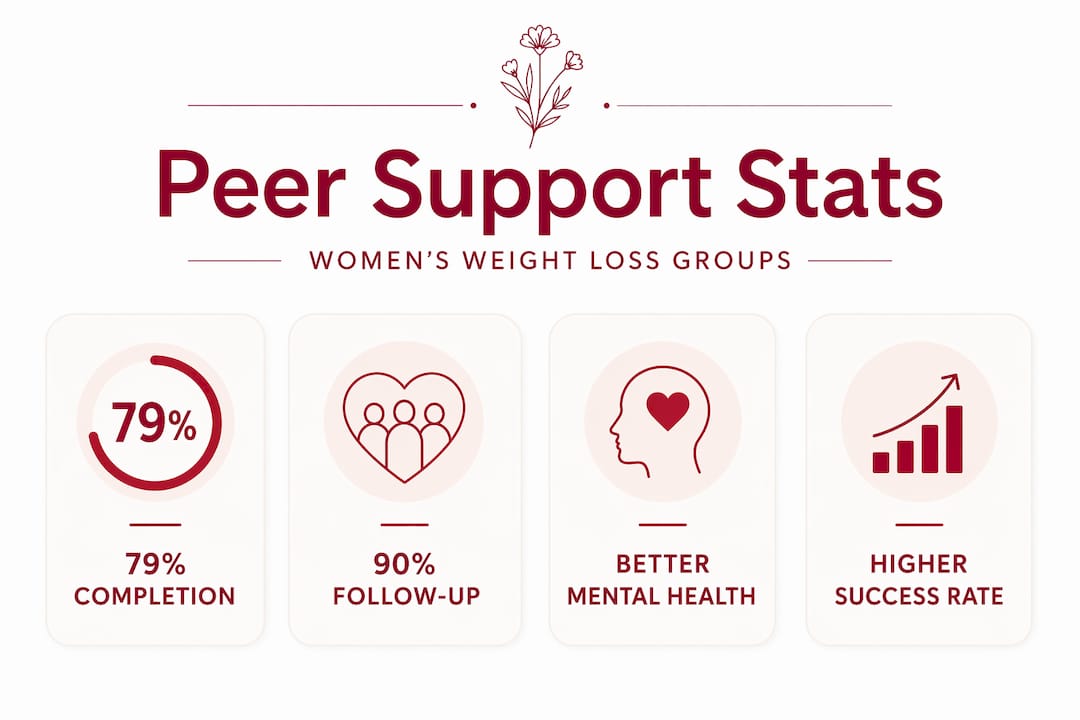
A digital peer support program focused on university students with pre-obesity found impressive results. Digital peer support programs achieved follow-up rates exceeding 90% over six months, with a mean weight difference of 2.58 kg at 12 weeks. That is not just a number. That is real, clinically meaningful progress driven by community, not medication or extreme dieting alone.
A separate group-based intervention targeting severe obesity showed similar strength. 79% of participants completed an 8-week multidisciplinary group program, with significant reductions in BMI, stress, and depression scores. Think about that. Nearly 8 in 10 people stuck with a challenging program because of the group structure surrounding them.

Program type | Completion rate | Key outcome |
Digital peer support (6 months) | Over 90% follow-up | 2.58 kg mean weight loss at 12 weeks |
Group-based multidisciplinary (8 weeks) | 79% completion | Reduced BMI, stress, and depression |
WeChat-based peer support group | Higher than control | Greater BMI reduction and psychosocial benefits |
The mental health benefits stand out just as much as the physical ones. A WeChat-based peer support group showed greater BMI reduction and psychosocial benefits compared to a control group over six months. Self-esteem went up. Loneliness went down. Both of those outcomes make it easier to stay consistent with healthy habits.
“Peer support provides connection, hope, and practical coping strategies. It offers something that clinical settings often can’t: the feeling that someone truly understands your experience.” — CMHA
The takeaway from the research is clear. Community support in weight loss is not a soft bonus. It is a measurable driver of results.
Common pitfalls and how to avoid them
Peer support is not automatically positive. Like any group dynamic, it can go wrong. Understanding the risks helps you find or build the kind of community that actually works.
The biggest threat is poor group culture. Disruptive members and poor facilitation are linked to weaker adherence in weight management programs. If someone in your group constantly complains, shames others, or derails conversations, it does not just annoy people. It drives them away. A single toxic dynamic can undo the benefits of an otherwise great group.
Here is what to watch out for when evaluating any peer support group:
No clear structure or purpose. Groups without shared goals drift into casual chat. That is fine socially but not effective for weight loss accountability.
Comparison culture. Healthy motivation and unhealthy comparison are close neighbors. Groups that focus on body image competition rather than healthy behavior change can actually harm self-esteem.
Lack of facilitation. Training in motivational interviewing improves outcomes significantly. Groups with a skilled facilitator keep conversations positive, goal-focused, and inclusive.
Inaccessible communication. Research shows that commercial groups with direct leader contact report higher engagement and less dropout. If getting a question answered requires a three-day wait, people disengage.
Not everyone starts with a ready-made social support network. That is completely okay. Social groups for weight management, both digital and in-person, exist specifically to fill that gap. You do not need a best friend who is also on a weight loss journey. You need a structured community that creates that connection for you.
Pro Tip: Before fully committing to any peer group, attend a few sessions without pressure to participate heavily. Watch how members treat each other. The culture you observe in the first two weeks is usually the culture you get long-term.
How women can put peer support to work
Knowing peer support works is one thing. Actually using it in your daily life is another. Here is how to build it into your weight loss routine in a way that sticks.
Find your format first. Some women thrive in in-person groups where body language and face-to-face energy create real connection. Others do better in digital spaces because of flexibility, privacy, or lifestyle. Be honest with yourself about which environment makes you more likely to show up consistently.
Set shared goals with your peer group. Accountability partners work best when everyone is working toward something specific. Instead of a vague “we all want to lose weight,” try “we are each committing to three workouts this week and checking in by Sunday.” Specificity drives results.
Use technology to stay connected. Apps, group chats, and virtual check-ins make peer support flexible enough to fit a busy life. You can find more tips on staying consistent while using community tools to maintain healthy habits even during hectic seasons.
Pair peer support with professional guidance. Peer support works best alongside expert care. The importance of accountability partners shines brightest when you also have a knowledgeable provider setting the framework, adjusting your plan, and tracking your progress.
Create micro-celebrations together. Women respond well to recognition and encouragement. Build a habit of celebrating small wins in your group, whether it is drinking enough water all week or finally trying a new workout class. These small moments build the emotional glue that holds a peer group together.
Rotate roles. Take turns being the one who motivates and the one who needs motivation. Peer influence on weight loss runs both directions. Giving support is just as reinforcing as receiving it.
Commit to consistency over intensity. Showing up every week with moderate engagement beats showing up intensely for a month and then burning out. Regular, reliable connection is what actually moves the needle over time.
Pro Tip: If you cannot find a group that fits your needs, start one. A group chat with three or four women from your workplace, neighborhood, or online community, built around a shared weekly check-in, can become one of your most powerful weight loss tools.
My honest take on peer support and women’s weight loss
I have watched women in supportive weight loss networks outperform women with far better meal plans and more expensive programs. And the reason is almost always the same. When someone genuinely cares whether you showed up this week, you show up.
What surprises most people is that the benefits of peer support are not just motivational. They are biological. Feeling connected lowers cortisol. Lower cortisol makes it easier to lose weight and avoid stress eating. The community is literally changing your hormonal environment.
But I also want to be honest: not all peer support is good support. I have seen groups where one person’s negativity poisoned the whole dynamic. I have seen well-intentioned accountability partnerships that turned into comparison spirals. The culture of your group matters more than the format. More than the platform. More than how many members it has.
Women’s unique social and emotional needs mean that how peer support feels matters just as much as what it delivers. You need a space that combines honest accountability with genuine warmth. That combination is rare, and when you find it, you protect it.
My advice: do not wait until you have a big, perfect group. Start with one person. One check-in per week. Let it grow from there.
— Anne Marie Noe, NP
How Wildflower Weight Loss makes peer support real
At Wildflower Weight Loss, we built our program around the truth that women do better together. Our weekly live group health coaching calls, monthly Girl’s Nights, and live video open office hours are not extras. They are the heart of what we do.
We combine that community energy with real medical support, including access to weight loss medications like Mounjaro, Wegovy, Zepbound, Semaglutide and Tirzepatide, plus AI-personalized training and customizable nutrition. You get the structure of professional care and the warmth of a peer community that actually gets your experience. If you are ready to stop going it alone, explore our women’s challenges and programs to find the right fit. Or start your journey today with a program designed by women, for women.
FAQ
What is the role of peer support in weight loss?
Peer support connects you with others who share your experience, reducing isolation and increasing accountability. Research shows it leads to greater weight loss and better mental health outcomes compared to going it alone.
How does peer support differ from working with a professional?
A professional diagnoses and prescribes. Peer support offers connection based on shared lived experience, which complements clinical care without replacing it. Both are valuable and work best together.
Do online peer support groups actually work?
Yes. Digital peer support programs achieve follow-up rates above 90% and produce clinically meaningful weight loss results, making them highly effective for women who prefer flexible, accessible community support.
What makes a peer support group ineffective?
Poor group dynamics, lack of skilled facilitation, and comparison culture all reduce effectiveness. Choosing a group with clear goals, positive culture, and accessible leadership makes a significant difference in outcomes.
How do I find a peer support group for weight loss?
Start by exploring structured programs like those at Wildflower Weight Loss, which integrate community coaching with professional support. You can also form a small group with trusted friends using a shared weekly check-in to build accountability from scratch.
Recommended