
The Real Role of Routine in Weight Loss for Women
- Anne Marie Noe

- Jun 8
- 9 min read

Most people assume that variety keeps weight loss moving forward. Switch up your workouts, rotate your meals, keep things fresh. But the role of routine in weight loss tells a very different story. Recent research shows that women who repeat meals and keep their daily calorie intake consistent actually lose significantly more weight than those who constantly vary their approach. Structure, not spontaneity, tends to win. If you have been chasing motivation and variety without seeing lasting results, this article will show you exactly why building consistent daily habits may be the shift that finally works.
Table of Contents
Key takeaways
Point | Details |
Routine outperforms variety | Women who eat consistent meals lose more weight on average than those who vary their diets weekly. |
Decision fatigue is real | Daily routines reduce the mental load of constant food choices, making healthy behaviors automatic. |
Sleep is part of the routine | Consistent 7 to 8 hours of sleep regulates hunger hormones and supports your calorie goals. |
Flexibility keeps routines alive | Building mindful flexibility into your routine prevents burnout and supports long-term success. |
Tracking trends beats tracking numbers | Daily weigh-ins work best as data points for spotting trends, not as daily pass or fail scores. |
How routine affects weight loss at the behavioral level
Let’s start with why routine works, because understanding the mechanism makes it much easier to commit to one. At the core is a concept called behavioral automaticity. When you perform the same behavior repeatedly in the same context, your brain gradually shifts that behavior from conscious decision to automatic habit. You stop debating whether to take a morning walk. You just do it.
This matters enormously for weight loss because the modern food environment is exhausting. Charlotte Hagerman, Ph.D. notes that routines reduce mental load, making healthy choices feel automatic rather than effortful. Every time you have to decide what to eat, whether to exercise, or how large a portion should be, you draw on a limited pool of mental energy. By midday, that pool is often already running low.
This is what psychologists call decision fatigue. The more choices you make throughout the day, the less willpower you have left for later decisions. Routines short-circuit that drain. When breakfast is the same every weekday, you are not making a decision. You are following a script your brain already knows.
Here is what that looks like in practice:
Meal timing: Eating at the same times each day removes the constant negotiation of “Is it time to eat yet?”
Exercise windows: Scheduling workouts at the same time each day makes skipping feel unusual rather than normal.
Grocery patterns: Buying the same core ingredients weekly means less browsing and fewer impulse decisions in the store.
Sleep anchors: Going to bed and waking up at consistent times stabilizes energy, hunger, and willpower the next day.
Pro Tip: Start with just one anchored routine, such as a consistent breakfast, and build from there. Trying to overhaul your entire day at once is the fastest way to abandon the whole effort.
The importance of daily routine is not just motivational advice. It is a behavioral strategy grounded in how the brain actually learns and sustains new patterns.
What the research says about routine eating and results
Here is where things get genuinely interesting. A 2026 Health Psychology study examined adults who repeated meals consistently versus those who varied their diets over 12 weeks. The results were striking.
“Participants who repeated meals lost an average of 5.9% of their body weight, compared to 4.3% for those following varied diets over the same period.” — Health Psychology, 2026
That gap does not sound dramatic until you do the math. For a woman weighing 180 pounds, that difference is roughly 2.9 pounds more lost in just three months. Simply by eating more of the same foods.
The same study found that calorie consistency matters significantly. For every 100-calorie increase in daily intake fluctuation, weight loss decreased by about 0.6% over the 12 weeks. Swinging between 1,400 calories on Monday and 2,200 on Saturday is not balance. It is variability working against you.
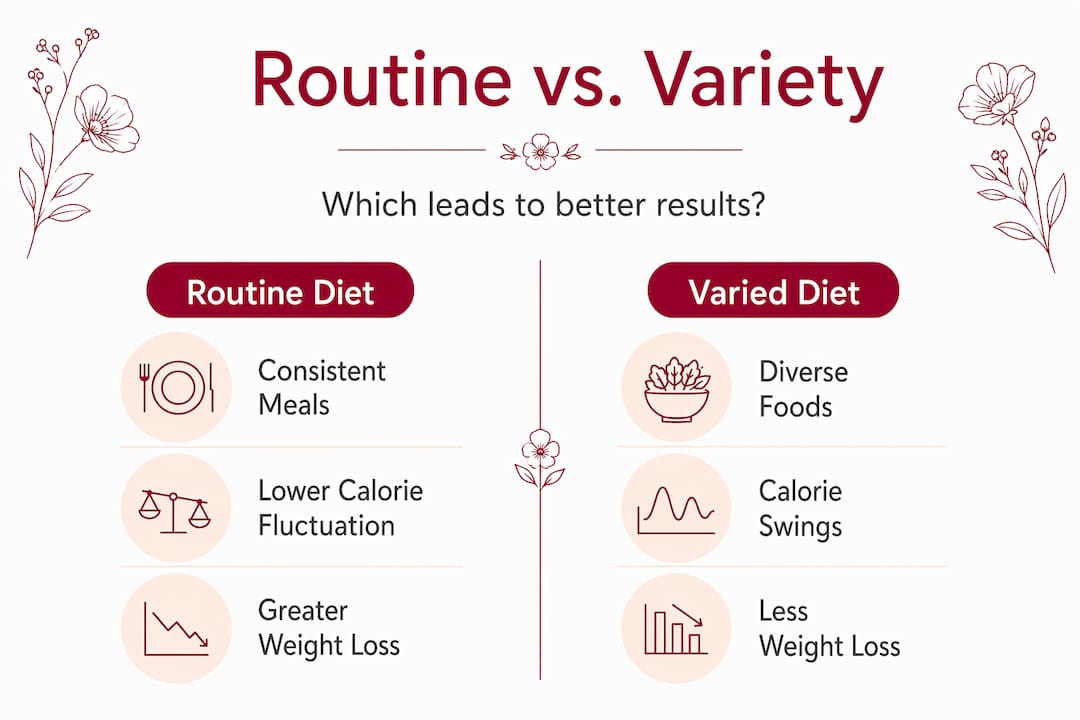
Here is a clear comparison of how routine versus varied eating patterns tend to play out:
Factor | Routine diet approach | Varied diet approach |
Average weight loss (12 weeks) | 5.9% body weight | 4.3% body weight |
Calorie consistency | High, day-to-day stability | Lower, frequent fluctuation |
Mental effort required | Decreases over time | Stays high throughout |
Risk of overeating | Lower due to familiarity | Higher due to novelty |
Long-term adherence | Stronger | More difficult to sustain |
One nuance worth calling out: routine eating does not mean nutritional monotony. The goal is calorie and behavioral consistency, not eating the same 500 calories of poor-quality food every day. You want your structure to work within nutrient-rich choices. Rotating between a few solid breakfast options, for example, gives you both consistency and enough variety to hit your nutritional bases.
Research also shows that consistent food logging is associated with better long-term outcomes. Participants who tracked their intake regularly, including on weekends, lost more weight than those who tracked only during the week. The habit of tracking, not just the act, made the difference. You can find more evidence-based strategies on the Wildflower Weight Loss blog if you want to dig deeper into the research side of this.
Building a daily routine for losing weight that actually sticks
Knowing that routine works is one thing. Building one you will actually follow is another. Here is a practical framework organized around the four pillars that most consistently support weight loss in women.
Anchor your meals to the clock. Pick three meal windows and stick to them daily, even on weekends. This stabilizes hunger hormones and removes the mindless snacking that tends to fill unscheduled gaps.
Create a simple meal rotation. You do not need to eat the same thing every single day. Rotating three to five breakfast options, four or five lunches, and a handful of dinners gives your brain the predictability it needs while keeping food enjoyable.
Schedule movement like a meeting. According to NIDDK guidelines, adults should aim for at least 300 minutes of moderate-intensity physical activity weekly to prevent weight regain. That is about 43 minutes a day. Block it in your calendar and treat it as non-negotiable.
Protect your sleep routine. Consistent sleep of 7 to 8 hours helps regulate hunger hormones, including ghrelin and leptin, which directly influence cravings and your ability to stay in a calorie deficit. Late nights do not just make you tired. They make healthy eating harder the next day.
Use daily weigh-ins as data, not verdicts. Daily weight tracking works best when you treat each number as one data point in a longer trend, not a reflection of whether you are succeeding. Weight fluctuates by 2 to 4 pounds daily due to water, digestion, and hormones. The trend over two to three weeks tells the real story.
Batch your planning. Spend 20 minutes every Sunday mapping out your meals and movement for the week. This single habit removes most of the daily friction that derails routines.
Pro Tip: If your schedule shifts frequently, anchor your routine to behaviors rather than exact times. For example, “I exercise right after my last work call” is more resilient than “I exercise at 5 p.m.” every single day.
Regular physical activity also offers benefits well beyond calorie burning, including improved mood, better blood pressure, and sharper mental focus. When exercise feels good, it is far easier to keep it in your routine.

Staying flexible without losing your structure
One of the biggest fears women have about routine is that it feels rigid. Social dinners, holidays, travel, and busy seasons can feel like threats to the whole system. They do not have to be.
The goal is not a routine you follow perfectly. It is a routine you return to consistently. There is a real difference. Here is how to build flexibility into your structure without losing the benefits:
Plan for exceptions in advance. If you know Saturday is a birthday dinner, adjust your other meals that day rather than abandoning the whole day. Keeping the structure of three meal windows, even if the food changes, preserves the behavioral habit.
Use a “minimum viable routine” on hard days. On days when everything falls apart, identify the two or three non-negotiables you will protect. Keeping breakfast consistent and getting even a 15-minute walk still counts as maintaining your foundation.
Rotate within categories. Swapping one grain for another or choosing different vegetables keeps nutrition broad while your behavioral patterns stay tight.
Maintaining healthy eating habits through the holidays is a great example of where this mindset pays off. Women who go into events with a flexible plan almost always do better than those who either restrict completely or abandon all structure entirely. You can also find practical tips for staying on track during challenging events in the Wildflowerweightloss resource library.
Why routine supports long-term weight maintenance too
Most conversations about weight loss focus on the losing phase. But what happens after? Research consistently shows that the behavioral habits that got you there need to stay in place to keep you there. This is where the role of structure in weight loss becomes even more important.
After losing weight, your metabolism adjusts. Hunger hormones shift. Your body works harder to pull you back toward your previous weight. Routine is one of your best defenses against that biological push. Here is what sustaining your routine after reaching your goal actually looks like:
Continuing structured meal timing, even when you shift to a maintenance calorie level
Keeping your weekly movement schedule, with at least 300 minutes of moderate activity to prevent regain
Monitoring weight trends weekly or daily, using the data to catch small gains before they compound
Treating sleep as a non-negotiable health habit, not just a weight loss tool
The compounding effect of diet, activity, and sleep working together inside a consistent daily structure is what separates people who maintain their results for years from those who regain within months. Each habit reinforces the others.
My take on routine as the real foundation
I have worked with a lot of women on their weight loss journeys, and the pattern I see most often is this: the ones who get results are not the ones who find the perfect diet. They are the ones who build a simple, repeatable structure and protect it even when motivation dips.
Motivation is unreliable. It spikes when you start something new and fades as soon as life gets complicated. Routine fills that gap. When your morning walk is just what you do on Tuesdays and Thursdays, you do not need motivation to do it. You need motivation to skip it.
What I find most encouraging about the recent research is that the bar for “routine” is actually pretty low. You do not need a military schedule. You need a few anchored behaviors that you repeat consistently enough that your brain starts treating them as default. That is achievable for almost anyone.
If you have been feeling like you lack willpower or discipline, I want to push back on that. You probably just lack structure. Build the structure first. The discipline follows.
— Anne Noe, NP
Start building your routine with Wildflower Weight Loss
We built Wildflower Weight Loss specifically for women who are ready to stop restarting and start building something that lasts. Our virtual weight loss program includes weekly live coaching calls, AI-personalized training, and secure messaging with your provider, all designed around your real life. We offer weight loss medications including Mounjaro, Wegovy, Tirzepatide, Semaglutide, and more, paired with a customizable dietary system that makes building your routine feel supported rather than solo. Explore our current challenges and programs to find the right fit for where you are right now. You do not have to figure out your routine alone.
FAQ
How does routine support weight loss?
Routine reduces decision fatigue and makes healthy behaviors automatic over time. Research shows that people who follow consistent eating and activity patterns lose more weight than those who vary their approach frequently.
What is the best daily routine for losing weight?
A good daily routine for weight loss includes consistent meal timing, regular physical activity, 7 to 8 hours of sleep, and a simple food rotation that keeps calories stable. Starting with one anchored habit and building from there is more effective than changing everything at once.
How many minutes of exercise should be in my routine?
NIDDK guidelines recommend at least 300 minutes of moderate-intensity activity per week to maintain weight loss. That breaks down to roughly 43 minutes per day, which you can split into shorter sessions.
Can I have flexibility in my routine and still lose weight?
Yes. The goal is to return to your routine consistently, not to follow it perfectly every day. Planning ahead for social events and keeping a few non-negotiable daily anchors, like consistent breakfast timing and regular movement, protects your progress without eliminating enjoyment.
Does sleep really affect weight loss routines?
Absolutely. Consistent sleep of 7 to 8 hours regulates ghrelin and leptin, the hormones that control hunger and fullness. Poor sleep increases cravings and reduces your ability to stick to your nutrition goals the following day.
Recommended